AI‑Powered Tools for
Safer, Faster Automated Mobility
Automated driving systems fail in ways no test plan anticipates. Tempero gives OEMs, simulation vendors, and insurers the tools to find those failures fast — and to understand the behavioral landscape behind them before regulators, courts, or the road does.
Our Solutions
OSCFuzzer – Intelligent Scenario Testing
OSCFuzzer transforms scenario testing for automated driving. Engineers simply describe high‑level test goals in natural language — safety, comfort, performance — and our integrated generative AI converts them into precise Signal Temporal Logic (STL) formulas, removing the complexity of formal coding. Powered by intelligent fuzzing, optimization algorithms, and machine learning, OSCFuzzer autonomously explores the vast scenario space to pinpoint critical edge cases and hidden vulnerabilities.
The result: faster, deeper insight into system behavior, enhanced robustness, and accelerated development cycles. Fully compatible with ASAM OpenSCENARIO, OSCFuzzer turns the scenario explosion into a strategic advantage.
OSCFuzzer “Plug & Fuzz” Architecture
Declarative Testing
Focus on what matters (test properties) — not on coding exhaustive test scripts. Let OSCFuzzer translate natural-language requirements into formal STL automatically.
Targeted Exploration
Intelligently explores the most promising areas of the scenario space, avoiding millions of irrelevant variations using hybrid optimization + ML.
Native Compatibility
Seamless plug-in into your existing simulation and testing pipelines via ASAM OpenSCENARIO 1.x compatibility.
Actionable Insights
Produces decision trees, heatmaps, and causal clustering visualizations to help interpret vulnerabilities quickly.
Design-Space Illumination
The efficiency gains above — fewer simulations, lower OPEX — are the immediate return. But OSCFuzzer delivers something harder to price and impossible to replicate manually: engineering intelligence your team could not have generated on its own.
Existing tools require engineers to define the question first — select two attributes, specify a grid, run simulations, read a frontier. The engineer’s intuition bounds what the tool can find. OSCFuzzer inverts this. As it searches for critical failures, it simultaneously maps the high-dimensional behavioral landscape of your system — autonomously surfacing which variables interact, and under which precise combinations of conditions those interactions become safety-critical.
SDVs and AV systems involve a genuinely new class of complexity: Ego vehicle dynamics, pedestrian behavior, traffic density, weather, time of day, V2X connectivity, and roadside infrastructure — all interacting simultaneously, in combinations that have no historical precedent. No engineer, however experienced, can pre-enumerate what matters here. The design space is too large, too new, and too non-linear for intuition to navigate.
OSCFuzzer does not wait for your engineers to ask the right question. It finds the structure of your system’s behavioral space — surfacing correlations between attribute X and attribute Y that only manifest when conditions Z, W, and K are simultaneously met. Insights that no predefined grid could surface, and that no team could reach by hand — regardless of how much time they had.
CARE – Contextual Automation Risk Engine
Tempero’s Pay‑As‑Your‑System‑Drives platform gives insurers precise, dynamic underwriting factors based on the real‑world performance of connected and automated vehicles. Powered by our Contextual Automation Risk Engine (CARE) — built on Tempero’s OSCFuzzer technology — it moves beyond static, historical models by simulating rich combinations of driver behavior, driving conditions, automation features, and V2X connectivity to produce personalized, explainable risk scores.
Fairer Pricing
Premiums aligned with the actual safety performance of each policyholder’s vehicle and driving context.
Smarter Risk Selection
Deeper insight into automation and driver factors to optimize underwriting.
Regulatory Alignment
Scenario libraries mapped to upcoming automated vehicle safety certification frameworks.
Causal Analysis – Post‑Mortem Assessment
Causal Analysis provides a rigorous framework for understanding why an AI‑driven incident occurred and ascribing responsibility. As the industry moves toward Level 3 automation, OEMs and insurers face a “Pandora’s box” of product-liability lawsuits. Our solution addresses this by applying counterfactual reasoning to raw event data.
By transforming telemetry and environment logs into modifiable structural equations, we enable objective “what-if” analysis. This scientific approach determines if an outcome would have occurred “but-for” a specific system action, providing legally defensible insights into accident causality.
Causal Modeling & Accident Replay Framework
Liability Protection
Address the L3 responsibility challenge with objective evidence. Transform high-risk AI incidents into clear, interpretable causal reports for legal defense.
Counterfactual Logic
Utilize “But-for” testing to simulate alternative worlds. Determine if different system decisions would have prevented a collision under identical conditions.
Accident Replay
High-fidelity digital twin reconstruction of events. Replay incidents from multiple sensor perspectives to understand the chain of causality.
Ascribed Responsibility
Quantify the influence of exogenous variables versus system actions to objectively ascribe accountability between actors.
Case Studies
Efficiency in ADAS/AD Verification: Navigating UN Regulation No. 157
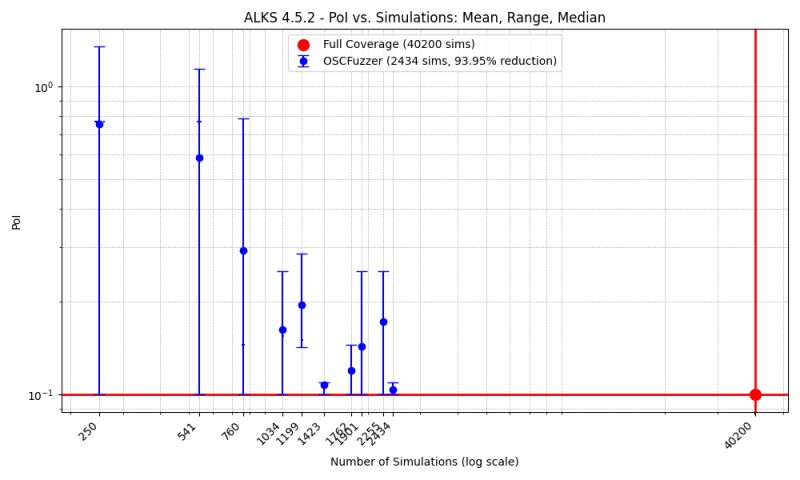
Tempero’s AI-driven verification suite addresses the “needle in the haystack” challenge of scenario testing, enabling OEMs to cut over 90% of costly simulations without missing critical edge cases. In this study, we focused on the most complex scenario defined in UN Regulation No. 157 (ALKS).
By applying the Tempero fuzzing suite, we identified the only 2 critical safety cases (just 0.005% of the valid configuration space) using a fraction of the traditional computational resources.
in compute & licensing costs
vs 40,000+ traditional runs
1 Million+
Scenarios generated to explore the complete ALKS configuration space.
40,000+
Valid simulation scenarios identified within the regulatory constraints.
0.005%
Proportion of scenarios representing critical safety-relevant edge cases.
Fine-Grained Risk Assessment of AEB in Urban Settings
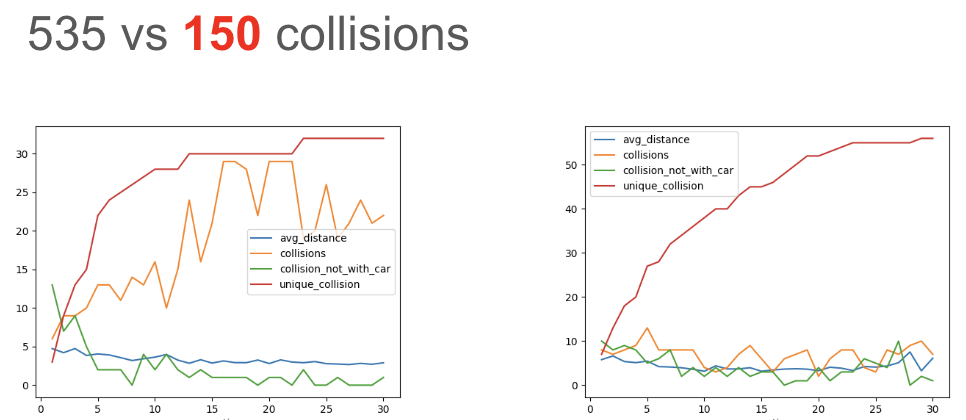
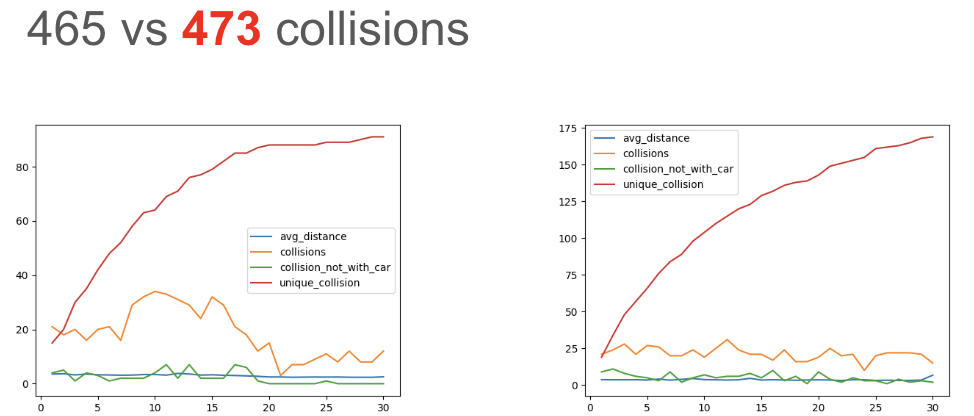
Using OSCFuzzer, Tempero conducted a detailed assessment of Automated Emergency Braking (AEB) in two urban settings with varying traffic densities (td1 and td2). We used around 12,000 optimization-driven virtual simulations to evaluate AEB’s effectiveness.
Setting td1
AEB significantly reduced the number of collisions.
Setting td2
AEB had minimal impact, indicating limited utility with this traffic density.
Implications
These results demonstrate Tempero’s ability to provide fine-grained risk assessments tailored to specific contexts. Unlike global statistics (e.g., IIHS studies based on past claims), our approach accounts for nuanced real-world contexts—crucial for new mobility involving V2I or V2V support. This precision enables accurate assessment of the value of automation (ADAS/AV) for insurers and end-users.
About Us
Founded on a Conviction
In 2020–21, before the EU AI Act was finalised, we identified a structural gap: L3–L5 safety certification implies scenario spaces of over one billion concrete tests, with OTA updates continuously resetting the clock as vehicles evolve at software pace. Exhaustive simulation is not merely expensive — it is structurally impossible.
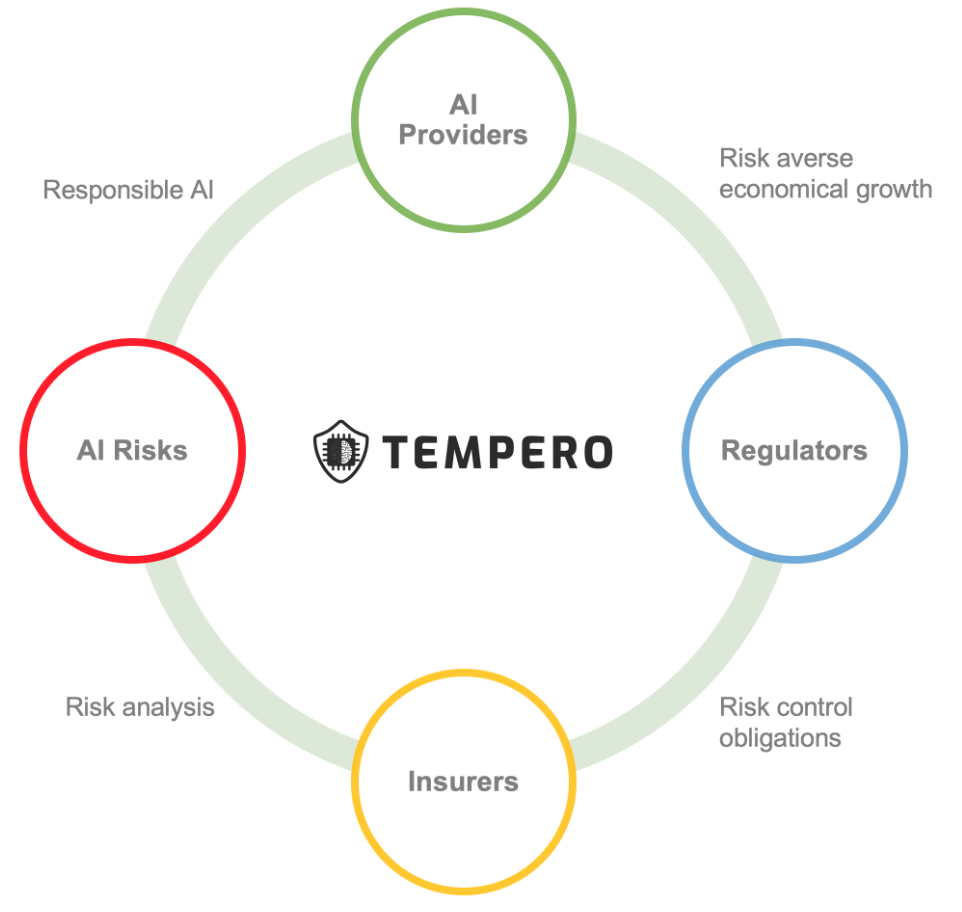
We built Tempero to close that gap, transferring large-scale formal verification methods into autonomous vehicle certification — a domain that needed them before it knew it did. Our founding team brings deep R&D backgrounds in automated reasoning, constraint solving, and software verification, with previous roles at Microsoft Research and in autonomous systems research.
The name “Tempero” comes from Latin: to temper, to make mild, to refrain from. To temper the risks of high-risk AI systems — before they reach the road.